

Two Clocks

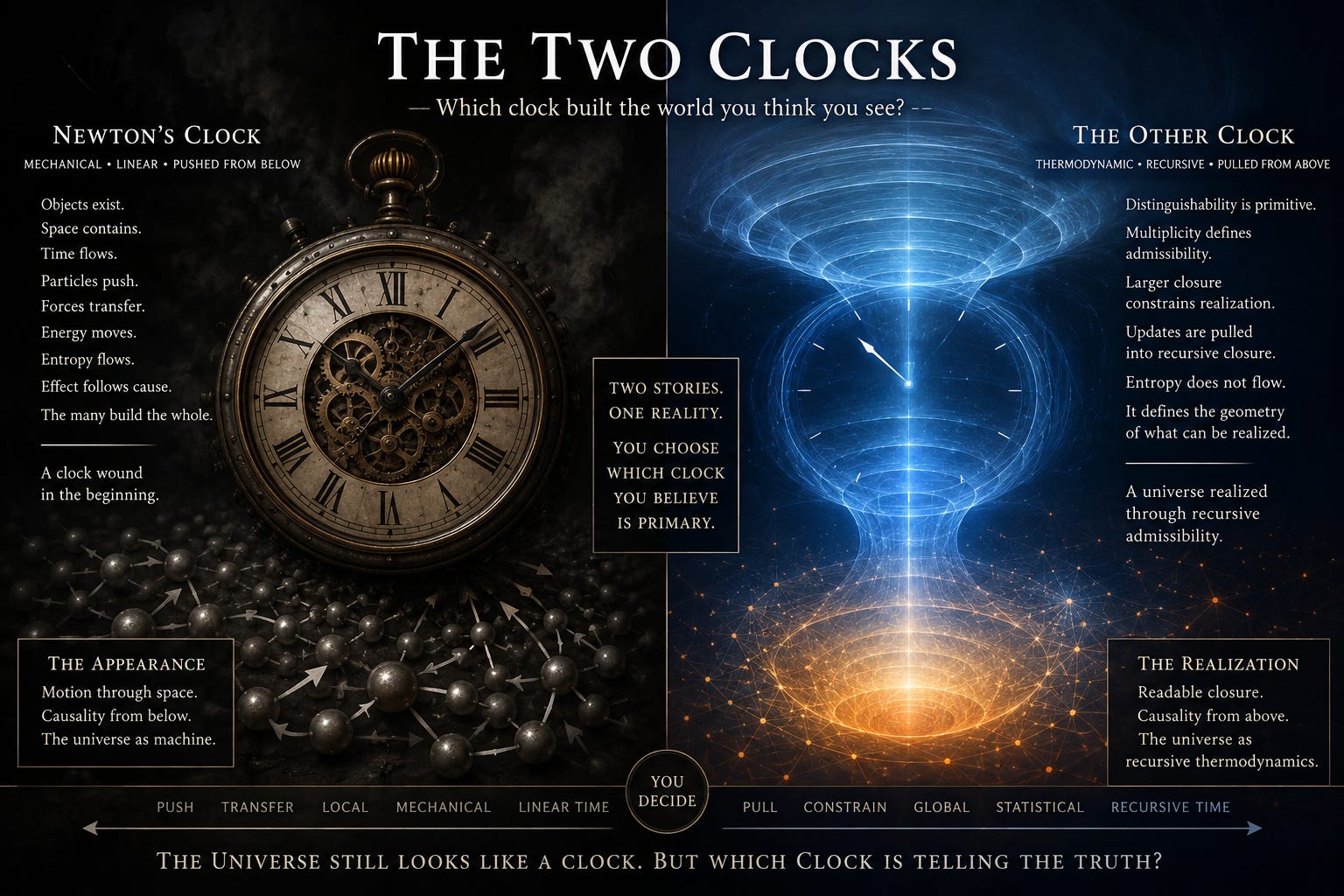
Newton imagined the universe as a clock.
A magnificent clock.
A perfect mechanism wound in the beginning and left to unfold according to immutable laws. Matter moved. Forces pushed. Time flowed forward uniformly in the background while the gears of reality turned predictably beneath it.
Modern physics still largely lives inside Newton’s clock.
Even quantum mechanics — despite all its strange language — usually preserves the same ontology underneath:
something exists,
something moves,
something pushes,
something causes.
The universe is treated as machinery.
The only debate is how complicated the machinery is.
But over the last twenty-five years studying muscle mechanics, thermodynamics, entropy, and recursive systems, I have slowly come to suspect that Newton’s clock is almost exactly backward.
Not wrong in what it observes.
Wrong in what it assumes is primary.
Because there may be another clock.
A far stranger one.
A clock that is not wound by stored energy.
A clock wound by possibility itself.
Newton’s Clock
Newton’s universe begins with realized motion.
The gears already exist.
The spring is already loaded.
Energy is already present.
The machine is already running.
Time is simply the unfolding of that initial condition.
In this picture:
microscopic motion causes thermodynamics,
molecular collisions create temperature,
local fluctuations generate structure,
and the future emerges from pushes originating in the past.
Everything flows upward from below.
This is the deepest intuition in modern science:
reality is built from smaller things mechanically interacting.
But thermodynamics has always contained a quiet contradiction.
Because thermodynamics does not fundamentally describe microscopic pushing.
It describes constraints.
It describes admissibility.
It describes which macroscopic states are sustainable.
Boltzmann’s great insight was not that molecules move.
Everyone already knew that.
His insight was that multiplicity matters.
Not all configurations are equally realizable.
The universe statistically falls into larger entropic wells because there are more ways to realize them.
That sounds innocent.
But it changes everything.
The Other Clock
In the canon I’ve been developing, the primitive object is not the particle.
It is not energy.
It is not space-time.
It is not force.
It is distinguishable countability.
Before realization.
Before motion.
Before trajectories.
Before clocks.
The primitive universe is not a collection of moving things.
It is an admissibility structure.
This is difficult to see because we instinctively think reality must begin with the objects we currently see. But realized objects already assume:
identity,
persistence,
geometry,
motion,
and time.
The canon instead begins with distinguishable multiplicity:
the possibility of realization itself.
And this leads to a startling inversion.
The universe may not begin with great energy.
It may begin with great possibility.
Absolute Zero Reconsidered
This completely changes the meaning of absolute zero.
In classical physics, absolute zero is imagined as deadness:
motion frozen,
energy minimized,
particles stopped.
But the canon suggests something much stranger.
At the primitive scale:
multiplicity exists,
distinguishable updates exist,
admissible closure exists,
yet nothing is realized across scales.
No readable displacement.
No macroscopic time.
No thermodynamic structure.
No space-time.
The primitive entropic well and primitive updates coexist on the same scale. This avoids infinite regress. But alone they remain something like a singularity:
self-contained,
unrealized,
not yet readable.
Only larger recursive entropic wells realize readable closure.
Only then does the universe become observable.
Only then does exported closure appear as distance.
Only then do recursive updates appear as time.
Only then does sustained retention appear as mass and temperature.
Temperature is therefore not primitive agitation.
Temperature is recursive closure tension.
Not the cause of microscopic updates.
The constraint under which microscopic updates become sustainably realizable.
A Universe Pulled Forward
This is where the canon becomes deeply counterintuitive.
In Newton’s clock, the past pushes the future.
In the thermodynamic clock, larger admissible structures pull realization forward.
This does not mean the future literally reaches backward in time.
It means admissibility is prior to realization.
The larger entropic well does not mechanically force smaller-scale updates any more than the tension on the largest gear physically pushes each pendulum swing.
But without the larger gear, the oscillations do not remain coherent.
Without the larger well, closure does not remain readable.
The universe is therefore not a machine driven from below.
It is a recursively admissible structure unfolding distinguishable possibility into readable closure.
The Great Inversion
This may be the deepest inversion in the entire canon.
Newton’s clock begins maximally realized.
The thermodynamic clock begins minimally realized.
Newton’s universe begins with motion.
The canon begins with admissibility.
Newton’s universe begins with force.
The canon begins with multiplicity.
Newton’s universe begins hot.
The canon begins at absolute zero:
not empty,
not dead,
but unrealized.
And from that unrealized possibility emerges recursive closure,
temperature,
mass,
space-time,
and eventually the appearance of the mechanical reality from which physics builds its clocks.
Physics repeatedly explains reality using structures that only exist after realization. Particles are defined through fields inferred from particle behavior. Space-time is treated as the background in which matter moves, even while matter itself defines space-time geometry.
The universe still looks clockwork-like from the outside.
But internally it may be the exact opposite of a machine.
Not a universe pushed forward by stored energy.
A universe realized through recursive admissibility.
I love how elaborately you are working on sorting all of this. You are so smart and creative. I think the thing that's missing is that the most important thing in the universe is spectrum particles spin which they picked up during the unbalancing of forces that finally can be made sense of by understanding the balance of forces and is what we call the Big Bang. What's interesting about this is that that spin is slowly lost but it results in the universe expanding and one day will be reversed. So the universe is cycling in a yo-yo fashion. It is carefully explained in my articles. Feel free to ask me any questions you like I would love you writing about these things cuz you are so clever. How can I help. You obviously want to present the correct ideas to your audience...