

Part 15: Why String Theory Never Solved the Right Problem

String theory is often described as an unfinished project—promising, mathematically rich, but awaiting experimental confirmation.
Within the framework developed in this series, a different diagnosis applies.
String theory did not fail because it has not yet found the right solution.
It failed because it was trying to solve the wrong kind of problem.
The problem string theory set out to solve
String theory arose from a genuine tension in twentieth-century physics.
Quantum field theory describes nature in terms of microscopic interactions among particles.
General relativity describes gravity as the geometry of spacetime—a macroscopic structure not reducible to forces.
String theory attempts to resolve this tension by replacing point particles with extended microscopic objects and embedding all interactions, including gravity, in a unified microscopic framework.
This is a bottom-up unification strategy.
What this strategy assumes
The strategy assumes something rarely stated explicitly:
If the correct microscopic ontology is identified, macroscopic causation will follow.
Entropy, work, time, and gravity are expected to emerge from the right microphysics.
This assumption feels natural.
It is also exactly the projection error that recurs throughout physics.
Why microscopic unification is insufficient
The framework developed here rests on a different principle:
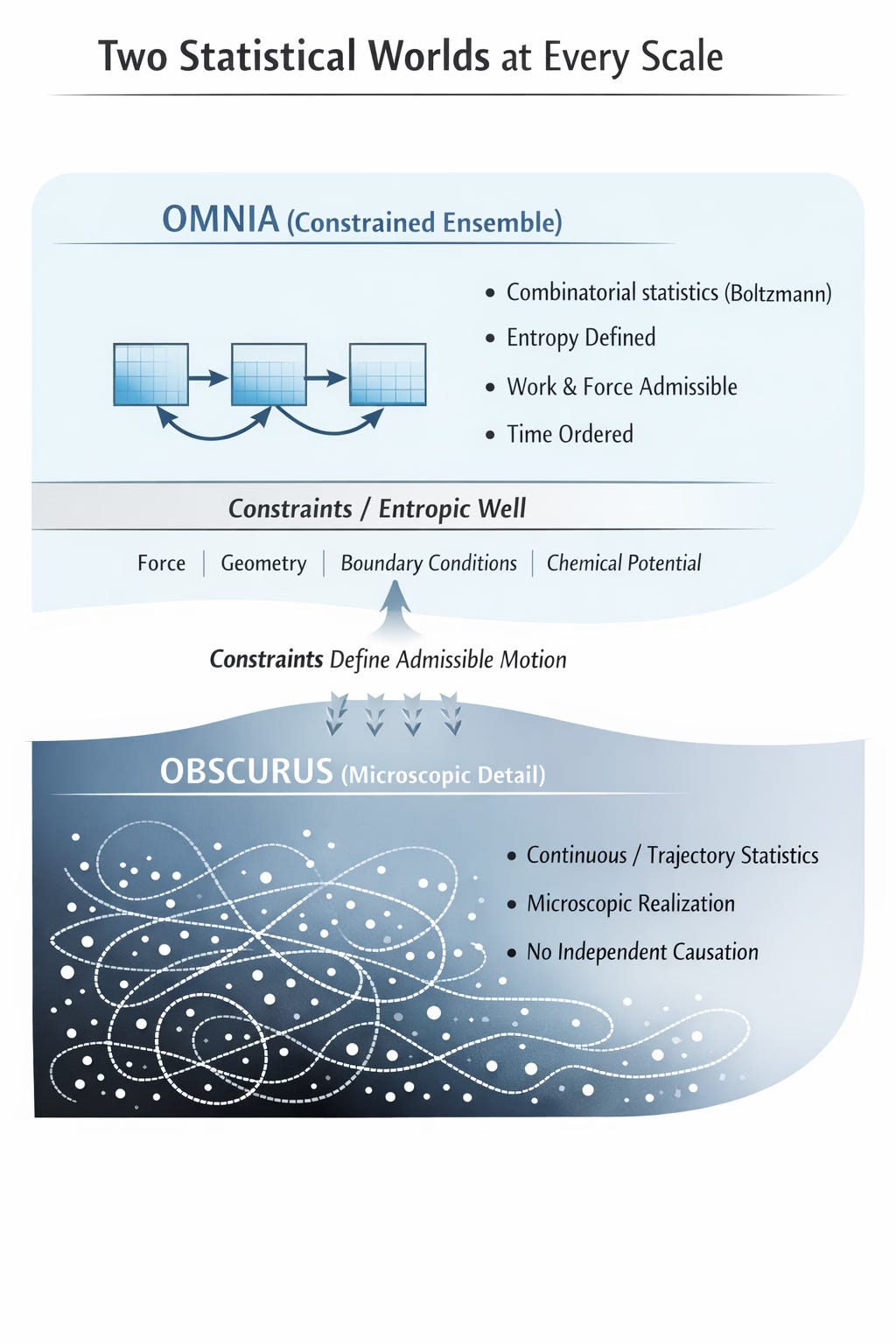
Macroscopic quantities—entropy, work, time, and causation—are not properties of microscopic constituents. They are properties of constrained ensembles.
They exist only when:
boundaries define systems,
ensembles define alternatives,
and irreversibility becomes meaningful.
No amount of microscopic detail can supply these conditions on its own.
Microscopic realizations populate state space.
They do not define it.
Where string theory lives
String theory operates entirely in the Obscurus:
microscopic degrees of freedom,
extended objects,
higher-dimensional configuration spaces,
mathematical consistency conditions.
It explores what is possible at the smallest scales.
What it has never specified—and was never designed to specify—is:
how entropy becomes defined,
how work is stored and transferred,
how time becomes ordered,
or how gravity functions as macroscopic containment rather than interaction.
These are Omnia-level questions.
Why the theory proliferates instead of converging
This placement explains a long-standing puzzle.
String theory admits:
a vast landscape of solutions,
many inequivalent vacua,
and few decisive constraints.
This is not a flaw in the mathematics.
It is what happens when a framework lacks macroscopic admissibility conditions. Without Omnia-level constraints, the Obscurus has too many degrees of freedom.
The theory expands because nothing forces it to collapse.
Gravity is the decisive clue
General relativity already tells us something crucial:
Gravity is not a force.
It is a geometric constraint on admissible motion.
Thermodynamic derivations of Einstein’s equations—such as Jacobson’s—make this explicit: spacetime dynamics behave like equations of state.
String theory attempts to microscopize this structure.
But constraints are not built from constituents.
They define the domain in which constituents matter.
Why string theory is not “wrong”
This framework does not falsify string theory.
It reclassifies it.
String theory may be:
a catalog of possible microscopic realizations,
a mathematical consistency program,
or a useful kinematic language.
What it cannot be—without additional structure—is a causal foundation for physics.
It does not explain why macroscopic physics has the form it does.
The deeper lesson
The failure of string theory is not empirical.
It is conceptual.
Physics does not advance by discovering ever smaller things and hoping meaning will follow.
Meaning enters physics when constraints enter physics.
And string theory, for all its sophistication, never specified the constraints that make causation possible.
Closing
String theory did not fail to answer the deepest questions in physics.
It answered a different question altogether.
Once that distinction is made, the long impasse surrounding the theory becomes intelligible—not as a mystery, but as a consequence of asking microscopic questions that were not macroscopically admissible.