

Mass, Inertia, and Time Dilation — Explained with Coins

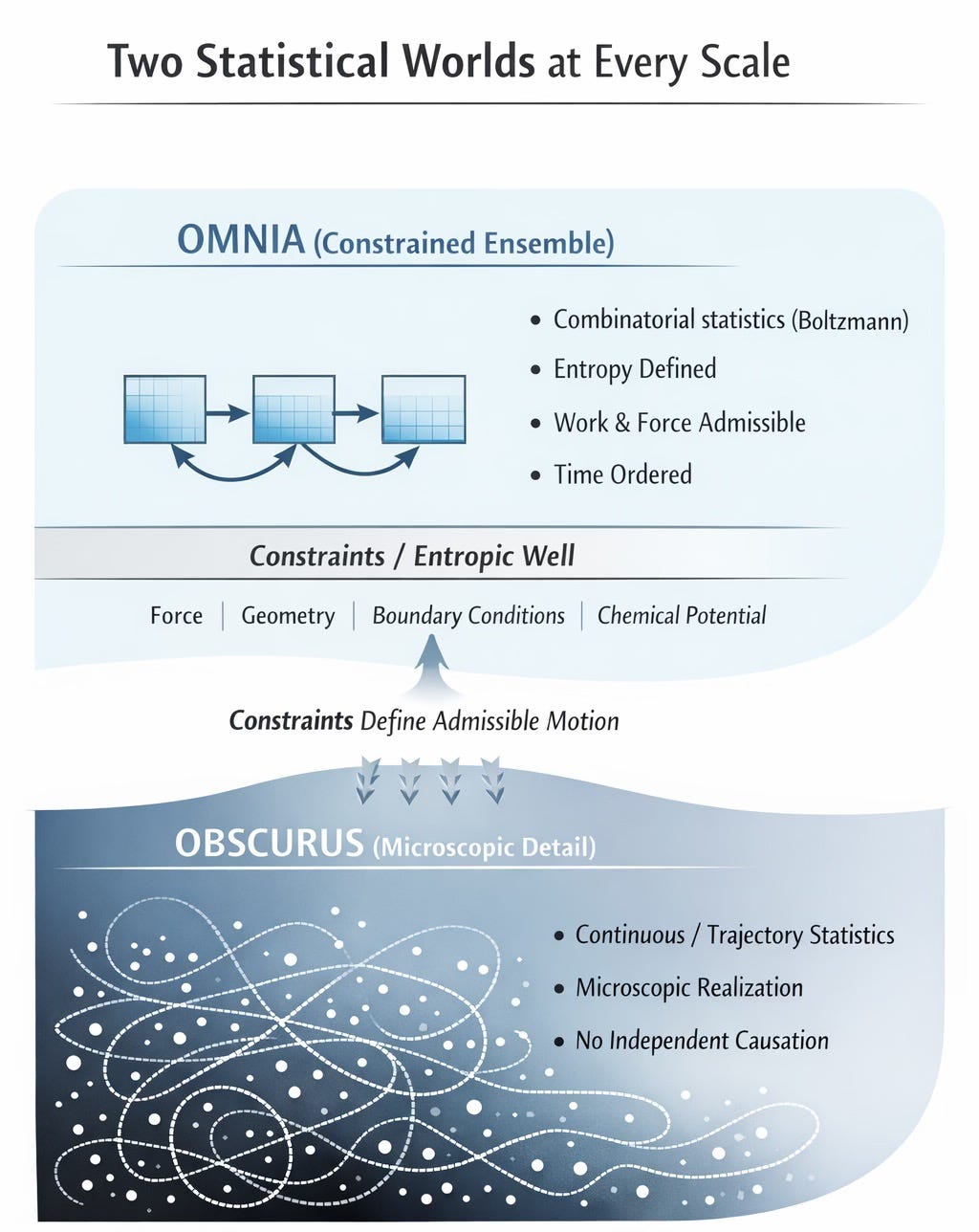
Physics treats mass, inertia, and time dilation as related but distinct phenomena. Mass resists acceleration. Inertial systems respond sluggishly to applied forces. Time runs more slowly in massive or accelerated frames. These facts are experimentally secure, yet their connection often appears formal rather than physical.
A simple statistical analogy — coins — makes their unity explicit.
Coins as a thermodynamic body
Consider a system of coins that can land heads or tails. Each toss is random and reversible. Microscopic details — trajectories, impacts, rotations — do not matter. What matters is the ensemble.
The macroscopic state is defined by the number of heads, NH, out of a total number of coins, N.
The multiplicity of an ensemble state is
WNH = N! / (NH! (N − NH)!)
The Boltzmann entropy of the ensemble state is
SNH = kBlnWNH
These ensemble states are ordered by entropy, forming an entropic well. States near NH = N/2 have overwhelming combinatorial weight.
Coins are tossed at a fixed realization rate, Γ. Each toss generates microscopic randomness (Shannon entropy), but only occasionally does it change the ensemble state in a thermodynamically meaningful way.
Small systems: light, responsive, fast
For small N, flipping a single coin produces a large relative change in the ensemble state. One realization can move the system substantially up or down the entropic well.
Consequences:
• Entropy changes rapidly
• The ensemble responds quickly to bias
• Directional change is easy
This is the statistical analogue of a light object. It accelerates readily because each microscopic event has macroscopic consequence.
Large systems: massive, inertial, slow
Now increase N dramatically.
Each toss still produces the same microscopic randomness.
The realization rate Γ is unchanged.
But almost every toss leaves the ensemble effectively unchanged.
The reason is combinatorial.
In a large ensemble, changing one coin alters W only negligibly. The system already occupies a region of overwhelming multiplicity.
Formally, near equilibrium,
Expected change in entropy per realization ≈ (dS/dX) × (ΔX per toss)
and since ΔX = ±1,
Expected ΔS per toss scales approximately as
⟨ΔS⟩ per toss ∝ 1 / N
As N increases, the probability that a realization changes the macroscopic state goes to zero.
This is inertia.
A massive object resists acceleration not because its constituents move differently, but because it has more structure to reorganize.
Acceleration as biased sampling
Apply a small bias to the coin system—favoring heads over tails.
For small N:
• The distribution shifts quickly.
For large N:
• The same bias produces only slow drift.
The bias is identical.
The realization rate is identical.
Only N differs.
Thus acceleration is suppressed not at the microscopic level, but at the ensemble level.
Mass is resistance to reorganization.
Time dilation from entropy evolution
In this framework, readable time is indexed by changes in macroscopic entropy S, not by the count of realizations.
If realizations occur at rate Γ, but only a fraction f(N) change the ensemble state, then the macroscopic entropy rate is
dS/dt ≈ Γ × ⟨ΔS⟩ per realization
Since ⟨ΔS⟩ per realization decreases with N,
dS/dt decreases even though Γ is unchanged.
Therefore:
• More realizations are required per unit macroscopic change
• Internal clocks tick more slowly
• Time appears dilated
Nothing microscopic has slowed.
What has slowed is how often realizations matter.
No noise, no waste, no dissipation required
It is incorrect to say that large systems produce more “noise.”
Large systems are quieter:
• Relative fluctuations shrink with N
• The ensemble is stable
What changes is efficiency, not randomness.
Shannon entropy (microscopic uncertainty) is produced at the same rate.
Boltzmann entropy (macroscopic structure) advances slowly.
Most realizations are thermodynamically invisible.
One phenomenon, three names
The same statistical fact appears as:
• Mass: number of admissible degrees of freedom
• Inertia: suppression of macroscopic change per realization
• Time dilation: slowing of entropy evolution relative to realization rate
No new forces are required.
No microscopic agency is invoked.
No spacetime geometry is needed.
The coins already contain the explanation.
Final statement
A massive system is not slow because time runs differently inside it.
Time runs differently because the system is massive.